 Save
Save There's something magical about opening your fridge on a Tuesday and finding a jar of soup ready to go, no excuses, no shortcuts. I discovered minestrone soup in jars by accident one hectic week when meal prep felt impossible, and I needed something I could grab without thinking. A friend had mentioned layering soups like a salad, and suddenly it clicked: why not build an entire Italian vegetable garden in glass, waiting patiently to be brought to life with hot water? Now these jars sit on my shelf like little promises of lunch sorted.
I brought these jars to my sister's house during a chaotic weekend when nobody wanted to cook, and watching her pour boiling water over the layers, then sit back amazed as it became soup, reminded me why I love this recipe so much. She immediately texted me the next week asking for two jars to keep at her office, and suddenly what started as my own lazy lunch hack became something I was making for other people who needed a moment of peace in their day.
Ingredients
- Small pasta (ditalini, elbow macaroni, or mini shells): Use about one-third cup; smaller shapes cook faster and distribute evenly through the soup without turning mushy before you eat it.
- Dried red lentils: These break down into the broth naturally, thickening everything and adding quiet protein that doesn't announce itself.
- Canned cannellini beans: Rinse them well to remove excess sodium, and they'll hold their shape rather than crumbling into the bottom of the jar.
- Carrots, celery, and zucchini: Dice everything to roughly the same size so they cook at the same rate and create a pleasant texture throughout.
- Frozen green peas: They stay firmer than fresh ones and don't leak color into everything else, keeping your soup looking bright.
- Baby spinach: Chop it roughly; it wilts dramatically when hot water hits it, so a little goes a long way.
- Sun-dried tomatoes: The oil-packed kind adds depth that fresh tomatoes can't quite match, and draining them keeps the jar from becoming greasy.
- Tomato paste: A tablespoon concentrates the umami, making the whole soup taste more intentional and less like you just threw vegetables in a jar.
- Italian herbs, garlic powder, chili flakes, salt, and pepper: Layer these with the vegetables so the flavors distribute rather than clustering at the bottom.
- Vegetable bouillon cube: Crumble it into powder before adding; this dissolves faster and seasons more evenly than a whole cube.
- Boiling water: Two cups per jar is the sweet spot; it covers everything and creates broth without drowning the pasta.
- Parmesan cheese: Optional but highly encouraged; a handful melts into the hot soup and adds a salty richness that makes it feel less like meal prep and more like something you chose to eat.
Tired of Takeout? 🥡
Get 10 meals you can make faster than delivery arrives. Seriously.
One email. No spam. Unsubscribe anytime.
Instructions
- Start with a clean slate:
- Grab four quart-size mason jars and make sure they're truly clean and dry; any moisture will make everything stick together and defeat the whole purpose of neat layers. I keep my jars in the cupboard rather than the fridge so they're ready when I remember to make soup.
- Layer the foundation:
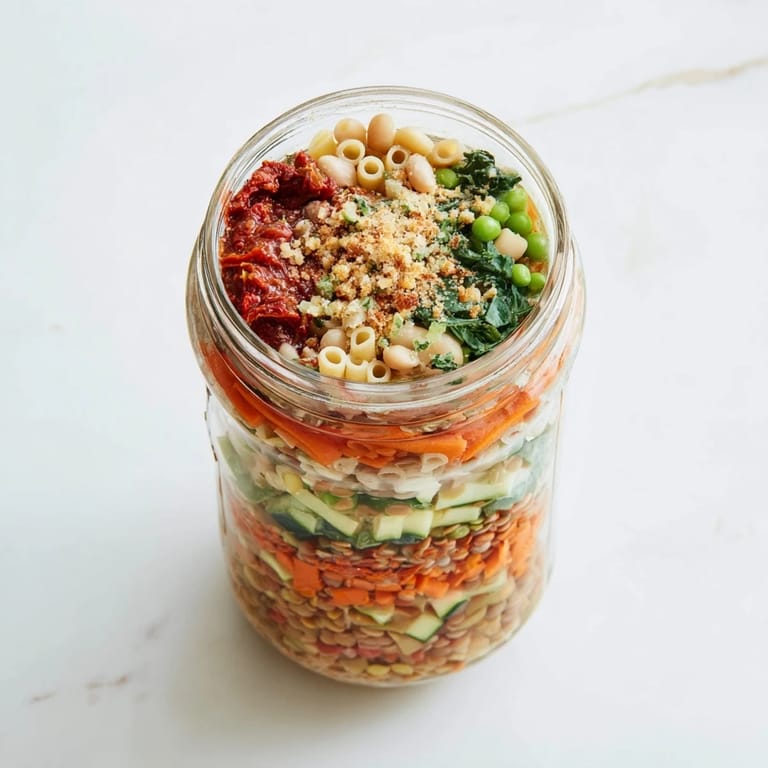
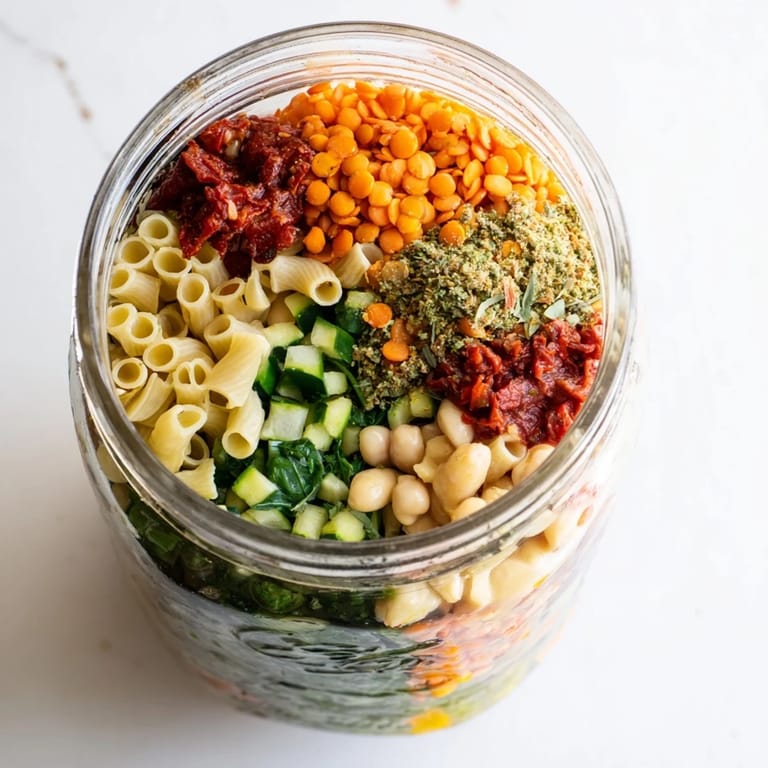
- Pour the small pasta into the bottom of each jar first, then add the lentils and beans directly on top. These form the sturdy base that won't shift around when you shake the jar later, and they'll absorb liquid slowly as they sit.
- Build the vegetable layers:
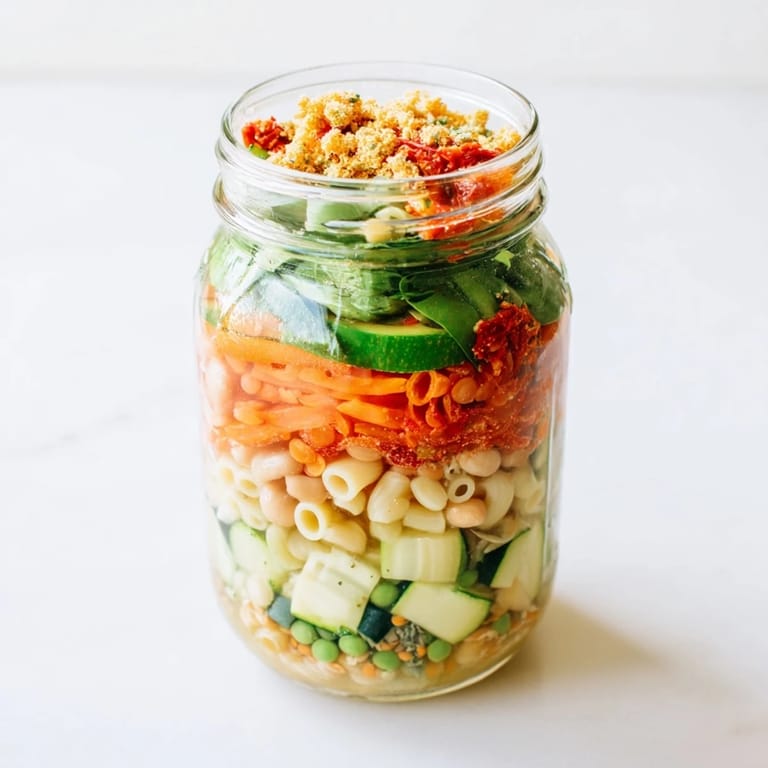
- Next comes carrots, then celery, then zucchini, then peas, creating a rainbow effect that's oddly satisfying to look at. Press gently as you go if things feel loose, but don't compress everything into a brick; you want water to eventually reach every layer.
- Top with brightness:
- Add the chopped spinach, sun-dried tomatoes, and a dab of tomato paste, then sprinkle the herbs, garlic powder, and bouillon cube powder evenly across the top. This final layer is where the magic lives, and it's worth taking a moment to make sure the seasoning isn't all clumped in one corner.
- Seal and store:
- Screw the lids on tight and refrigerate for up to four days; the jars become little time capsules of soup potential. I keep mine on the middle shelf where I see them every time I open the door, which means they actually get eaten instead of forgotten.
- Bring it to life:
- When you're ready to eat, add two cups of boiling water to the open jar, stir well, and let it sit for ten to fifteen minutes while the pasta softens and everything melds together. If you're impatient like I am, microwave it for three to four minutes instead, stirring halfway through, and you'll have soup in moments.
- Finish strong:
- Taste it, adjust salt and pepper if needed, and top with Parmesan if you're not keeping it vegan. A splash of olive oil or a handful of fresh basil at the end elevates it from convenient to genuinely delicious.
 Save
Save There was a morning when I grabbed a jar without thinking, added water, and realized I'd made it three days earlier and forgotten. Instead of tossing it, I heated it anyway, and it tasted even better than the fresh ones; the flavors had gotten to know each other in the fridge. That's when I understood this wasn't just meal prep—it was actually letting soup improve with time, like a small gift you give yourself.
The Art of Even Layering
Getting the ingredients to sit in distinct layers instead of blending together is honestly easier than it sounds, but it requires a gentle hand and patience. The pasta goes in first because it's sturdy enough to support everything above it, and the weight of subsequent layers naturally compresses things without you having to force it. I used to fuss over this part, tapping jars and adjusting layers obsessively, until someone pointed out that perfection doesn't matter—the soup will taste identical either way. Now I just go for it, and if a bit of carrot ends up in the lentil layer, so be it.
Customization Without Guilt
The beauty of soup in a jar is that you can swap almost anything without calculating percentages or ruining ratios. Don't like zucchini? Use diced bell pepper or fennel instead. Have a bag of white beans instead of cannellini? They'll work just as well. The formula is simply starch plus legume plus vegetables plus flavor, and your fridge usually has everything you need to make that work. I've made these with whatever was wilting in my crisper drawer, and somehow they always turn out right.
Why This Works as Meal Prep Magic
There's real psychology behind keeping prepared food visible and accessible, and these jars exploit it perfectly because they're beautiful to look at. When you open your fridge and see layers of vegetables instead of a plastic container you need to guess the age of, you're more likely to grab it. I've noticed I eat lunch more consistently now because I don't have to convince myself to open the fridge, decide what to eat, and then assemble anything. It's all there, waiting.
- Keep a kettle ready so you can make these jars in minutes whenever hunger strikes, morning or evening.
- Label jars with the date you made them so you don't accidentally keep one past its prime and wonder why it tastes off.
- Make four at once even if you only think you'll eat two; you'll almost certainly want a third one by Wednesday.
 Save
Save This soup has become my answer to the question I ask myself every weeknight: what's actually reasonable to eat when time is short and energy is shorter? It's turned out that reasonable sometimes means showing up for yourself with something that took ten minutes to assemble and tastes like you tried, even when you barely did.
Recipe Q&A
- → How long can I store the jars in the refrigerator?
Store sealed jars in the refrigerator for up to 4 days. The layered ingredients stay fresh and the flavors meld together, making them ideal for meal prep at the beginning of the week.
- → Can I use frozen vegetables instead of fresh?
Yes, frozen vegetables work perfectly in this preparation. They layer just as easily and maintain their nutritional value. No need to thaw them before layering—simply add them directly to the jar.
- → What pasta shapes work best for this soup?
Small pasta shapes like ditalini, elbow macaroni, or mini shells are ideal because they layer compactly and cook quickly when water is added. Avoid long pasta shapes that won't fit well in the jars.
- → How do I make this vegan?
Omit the Parmesan cheese topping and ensure your bouillon cube is vegetable-based and dairy-free. All other ingredients are naturally plant-based, making this an easy vegan adaptation.
- → Can I prepare these jars in advance and freeze them?
While refrigeration is recommended for up to 4 days, freezing is not advisable as the texture of vegetables and pasta may be compromised. Prepare jars 2-3 days ahead for best results.
- → What's the best way to heat the soup if I don't have boiling water?
Microwave the open jar (without the metal lid) for 3-4 minutes, stirring halfway through cooking. Alternatively, pour the jar contents into a pot and heat on the stovetop until the pasta is tender and vegetables are soft.